
An artwork is a series of errors. From the moment you start, right through to the end.
We Want to Florish
Floral imagery becomes the perfect metaphor for this reflection. Flowers embody our spirituality and true essence, the part of us that longs to bloom but is too often suppressed by the weight of work and the demands of survival. People are rightly praised for being hard workers, yet we must question where that effort is directed. Too often, it is consumed by jobs, justified by the belief that we are providing for our families. What is overlooked is the deeper need to invest that same devotion into ourselves, our inner growth, and the time we spend with those we love. This floral-themed artwork reveals the hidden picture within the beauty, fragility, and holiness of our being. It is also a quiet but urgent cry for attention, a reminder that art is more than just expression; it is also about healing. We begin to mend ourselves via art, and we can only provide real love and healing to our families once we have healed. True love is demonstrated not by relentless labour, but through presence, sensitivity, and the confidence to pursue our passions. Flowers remind us that our abilities are seeds waiting to bloom, not merely for the benefit of others, but also to enrich our own lives and radiate beauty outward.

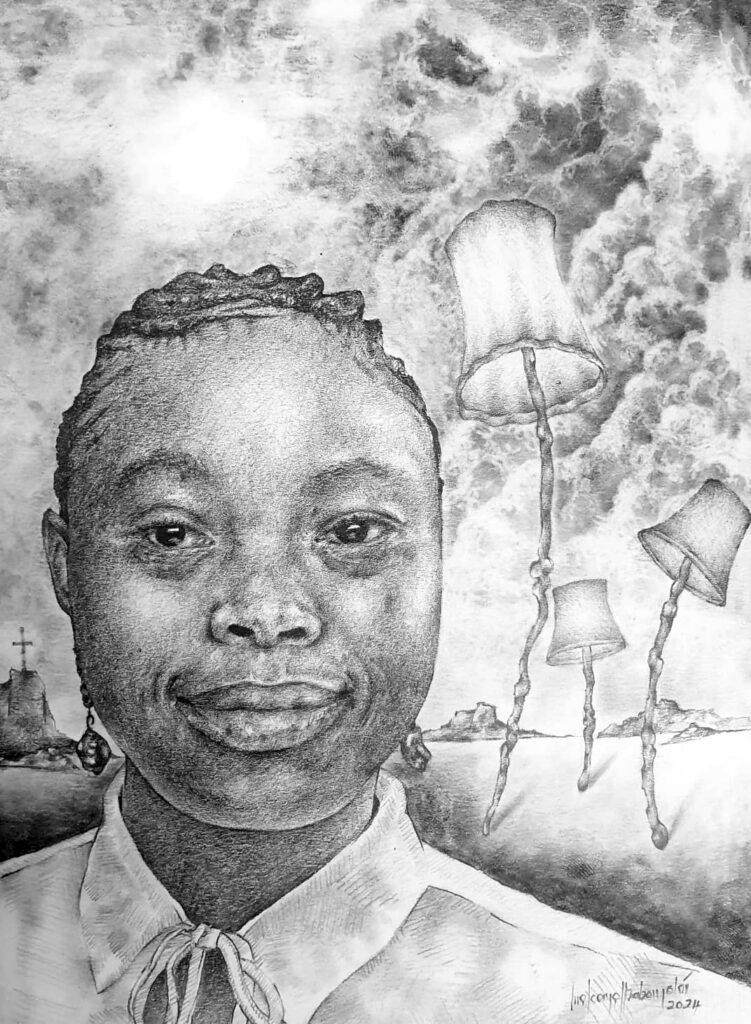
Maria: Guider of Hope
This artwork celebrates the profound role of a dedicated caregiver – a teacher – who serves as both a nurturer and a guide to learners. The composition positions the teacher prominently in the bottom-right corner, occupying nearly half of the visual space. This placement establishes her as the foundation and focal point of the piece, with the surrounding elements serving as a narrative backdrop that underscores her purpose and influence. The symbolism in the artwork draws parallels with the biblical figure of Maria (Mary), the mother of Jesus. Just as Maria was entrusted with raising and guiding the Savior from infancy, this teacher embodies the virtues of strength, resilience, and wisdom in nurturing her students. As depicted in scripture, Maria's leadership laid the foundation for a divine mission, a parallel echoed in the teacher’s role as a leader and shaper of young minds. The teacher in this artwork is not only a provider of knowledge but also a spiritual mentor, inspired by the Holy Spirit to instil both academic content and divine truth, aligning with the sentiment expressed by Welcome Thabo Moloi: "Teaching academic content without the truth is meaningless, and often destructive." In this depiction, the teacher, like Maria, becomes a shepherd leading her students toward a brighter future. The students are symbolised by lampshades, representing hope. Their brightness is dependent on the guidance they receive, emphasising the importance of strong, moral leadership. However, the artwork acknowledges that not all who are placed as guides fulfil their roles effectively. Maria, the teacher portrayed, derives her strength and wisdom from God, symbolised by the cross atop the highest mountain in the composition. The partly cloudy sky further conveys a sense of divine presence and the holiness that informs her mission as the "Guider of Hope." This intricate portrayal positions Maria as a beacon of light and a vessel of God’s will, entrusted with shaping the next generation to illuminate a path toward a brighter, more hopeful world.
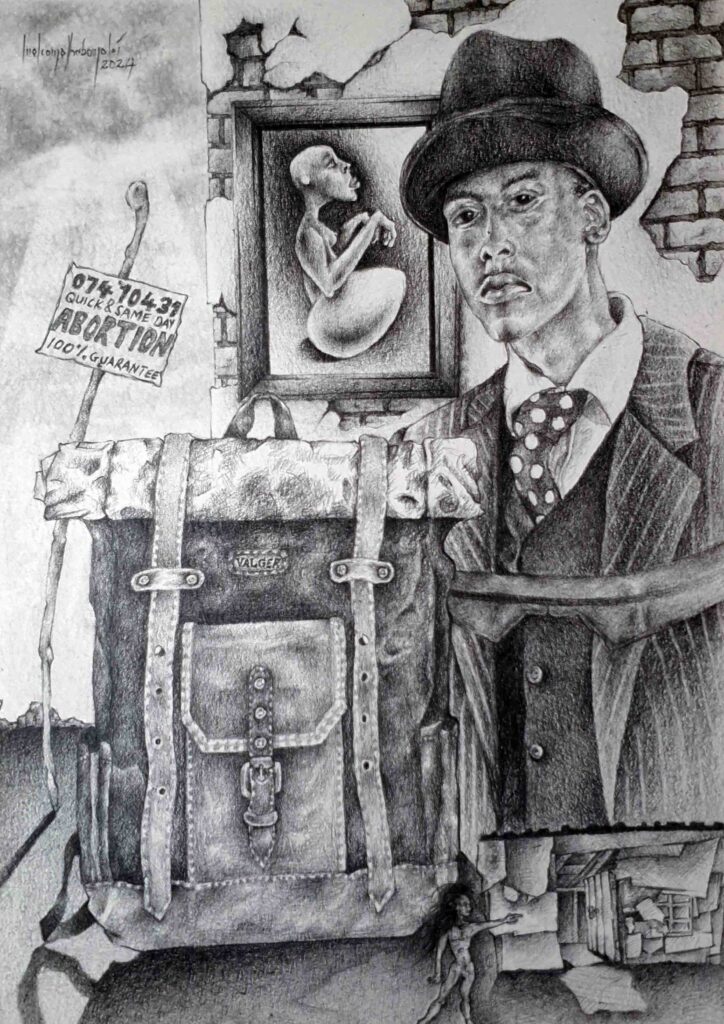
The Student & His Baggage
The Student and His Baggage tells the story of a young graduate caught between ambition and the inescapable weight of his origins. The composition unfolds in a visual cycle - beginning with a small figure pointing to a shack, moving through the student, a picture frame, an abortion board, a bag, and returning to the shack. This symbolises the persistent pull of his past. The shack’s open door invites viewers to imagine its dim interior, a metaphor for the poverty he hopes to leave behind. At the centre, the student stands in his best, perhaps only, suit. His recent graduation marked in his attire, yet shadowed by unemployment. The polka-dot tie and striped jacket contrast youth and maturity, reflecting his transition to adulthood. Behind him hangs a framed image of a pregnant woman intertwined with an egg, representing fertility, juxtaposed against a nearby board advertising “abortion, quick save, 100% guaranteed,” a clash of life and death. At his feet, the bag, his “baggage”, embodies his burdens, past, and uncertain future. The fractured wall in the background, with exposed bricks, reflects cracks in his life and harsh truths now revealed, while the combination of dark interiors and bright exteriors mirrors his hidden struggles and outward resilience. Rectangular forms repeat across the shack, bag, board, bricks, and frame, reinforcing a sense of confinement. The narrative reveals that during university, he fell in love, acted impulsively, and now faces an unplanned pregnancy. His decision, whether to keep the child or prioritise other responsibilities, is shaped by his background, the expectations of his community, and the family relying on him. The small pointing figure serves as a warning: without wise choices, he may be pulled back into the cycle of deprivation and the darkness beyond the shack’s door, echoing struggles faced by generations before him.
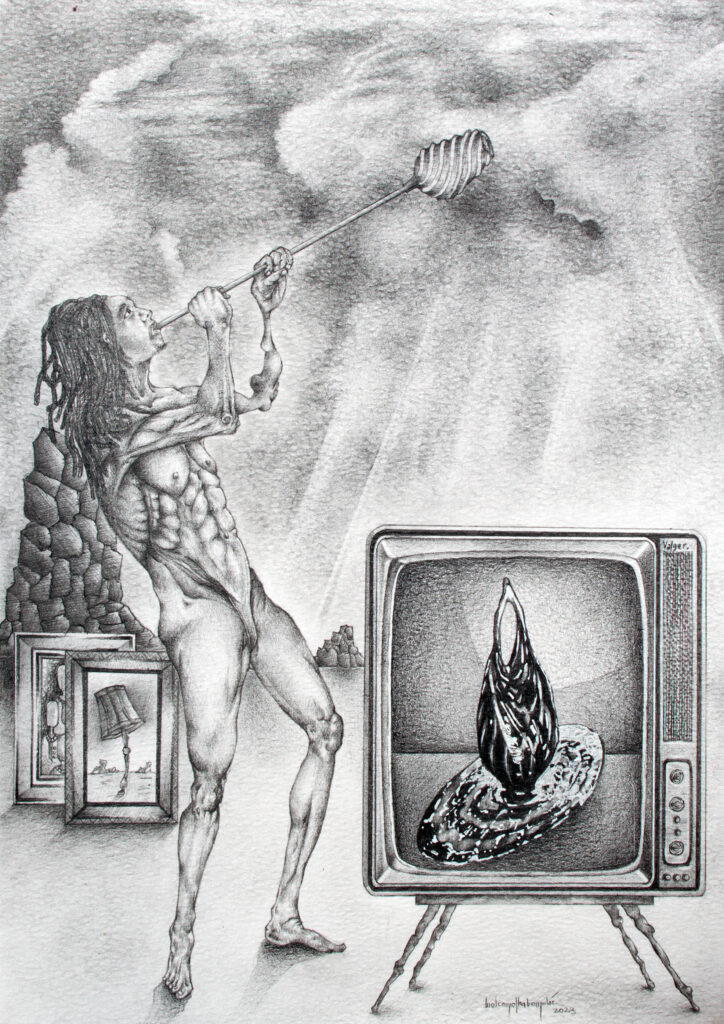
The Glassblower
This artwork is inspired by an artist and friend, Kgotso Edmund Pati. A young enthusiast I met in our first year of university. I know him in both his weak and strong moments. From a young glass student to one of South Africa's greatest glass artists. Pati is shown in action in this artwork, enjoying pushing the limits of the soft glass he works with while creating one of his expressive sculptural objects. He is depicted as muscular, alluding to his resilience and devotion to the medium of glass. Pati's glass sculpture is on display on a television set. This particular sculpture is significant because it was purchased as a graduation present for myself. Furthermore, this sculpture is loaded with mystery and is thought-provoking. In the one picture frame, a lampshade is shown. This lampshade embodies the light Pati has within him and resembles how his shine will inspire a lot of young artists in South Africa. He elucidates his art as a subtly interspersed radiant palette in pieces like 'Nkgo' (Pot) boggles the mediums' propensity to sustain both opacity and transparency simultaneously. This is the nature of glass: elusive, unbound, and fluid. 'Nkgo' (a pot), which assumes the form of a vessel, is glaring and lush in colours of various tones and pigments. An uncritical look would most likely render it as merely 'decorative' however, the 'abstract expressionist' impulse is quite evident. On this note, "my technique warrants us to take an imaginative leap and engage with the implicit 'meta-objectness' of the work, which transcends the materiality of the object and invites us to potentially experience its hidden visual punctum".
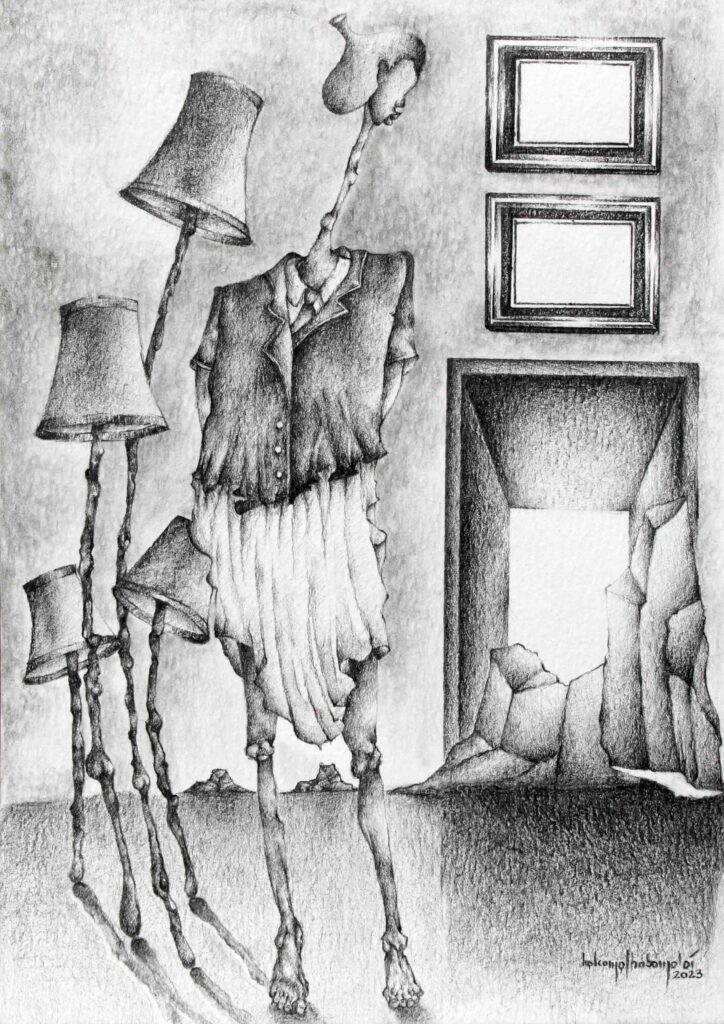
Light of the Future
Children are the future. They are the so-hoped-for light. As seen in the artwork, children are portrayed as lampshades, alluding to effulgence. How bright each light shines is dependent on how much current has been consumed. Current is self-same as wisdom. Thereby, they are depicted in different heights and sizes to delineate their development. A majestic figure erects firmly in front of these lamps and hints that this figure may be the leader. This is further visible in the formal dress code and humble posture. A mentor that leads the light to the future. On the far right of the composition, one sees a doorway with mountains in front of it. This doorway is a caliper and passage to the unknown future. While the mountains suggest that many challenges lie ahead. Nonetheless, the two blank picture frames portrayed present the unknown future, yet indicate that whatever happens in the future will ultimately be the past or present that one is either happy or unhappy with. The purpose of picture frames is to house stories and experiences embedded in pictures. What will be captured and exhibited in these frames is entirely dependent on the 'light' of the future. This future will be the reality for all of us.
Cover Yourself
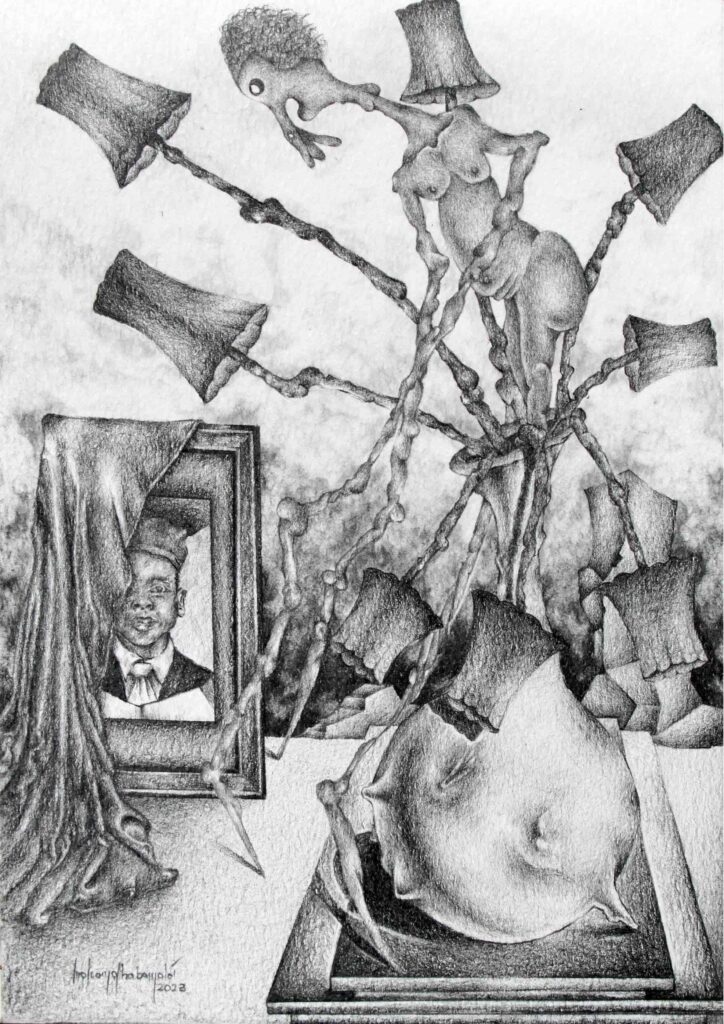
In the world exists both good and bad, holy and evil. This artwork portrays the harsh reality of young people's dreams that are captured through the loss of their innocence. An exaggerated figure is placed on the top right-hand corner of the composition, with lampshades spread around it. Although these lamps are none living, one can see their agony through how they are shaped and depicted. This firm figure is that of a Dream Reaper. The Reaper captures young unguarded souls. These souls are represented as lampshades captured in a receptacle. The souls' desperate attempt to escape is evident in the diffused lamps. Some are portrayed in an upright posture, indicating the strength they still possess to make efforts to break free, and others are portrayed in sagging postures which resemble hopelessness and feeble. The freestanding figure and lampshades are further emphasized by being placed on a base. They are like casted statues that constitute the current situation in the world, where we lose young people to immorality. The half-covered picture frame colligates with the title of this artwork - cover yourself. This implies that young people should protect themselves from the evil that exists in the world. The picture frame in the artwork accommodates a photo of a graduate. This frame is fractionally covered with a cloth. The cloth pertains to the protection mentioned above. In the case of this young graduate, he has lost much of his innocence, and he is therefore exposed. As a result, the Reaper is drawn to the young man, and ultimately, his soul will be taken without inquiry or negotiation.
The Mountain In-between
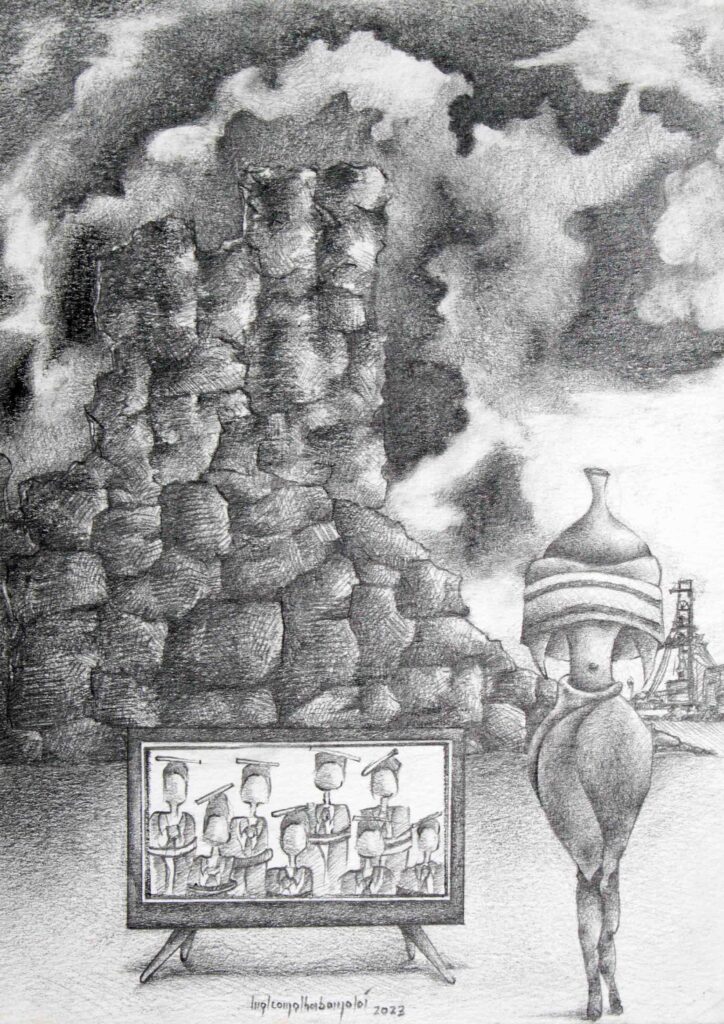
This artwork does not particularly have a focal point, as elements in the composition play a huge role in illustrating the message behind the work. One would argue that the mountain is the focal point. However, the mountain acts as brace to the meaning of the artwork. The mountain represents a bridge between the past, present and future. This passageway from the past and present, leads to the future, therefore, provides hope. As seen in the artwork; a figure stands in a neutral pose, this figure represents the knowledge giver, which are teachers; a flatscreen television set is seen resting on the bed of the ground with an image of graduates imbedded on the screen, these graduates allude the possible future; in the background, a mine shaft is included, representing the economy of the country. Ultimately, the future of the country and its economy is determined by knowledge attained by these graduates. The mountain also symbolizes the struggles that these graduates will have to endure to reach success.
Looking Back
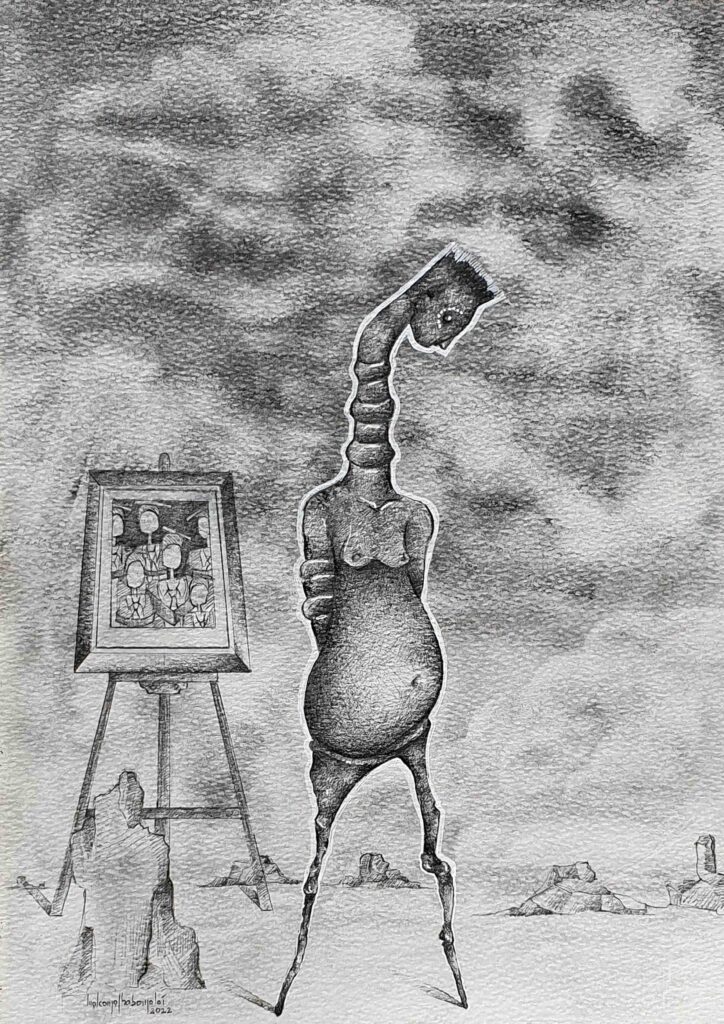
This artwork is about a young man who constantly looks back and reflect on all the things he did and did not do. He is shown naked, which represents vulnerability and truth – truth to himself and truth to his situation. This is also visible in his back-placed hands and facial expression. His hanging head further conveys a sense of remorse. We see an exhibited picture frame with a picture of graduates behind him. This could be a representation of his past or background. What could have happened in the past to cause such sadness in this young man?
Boldyer
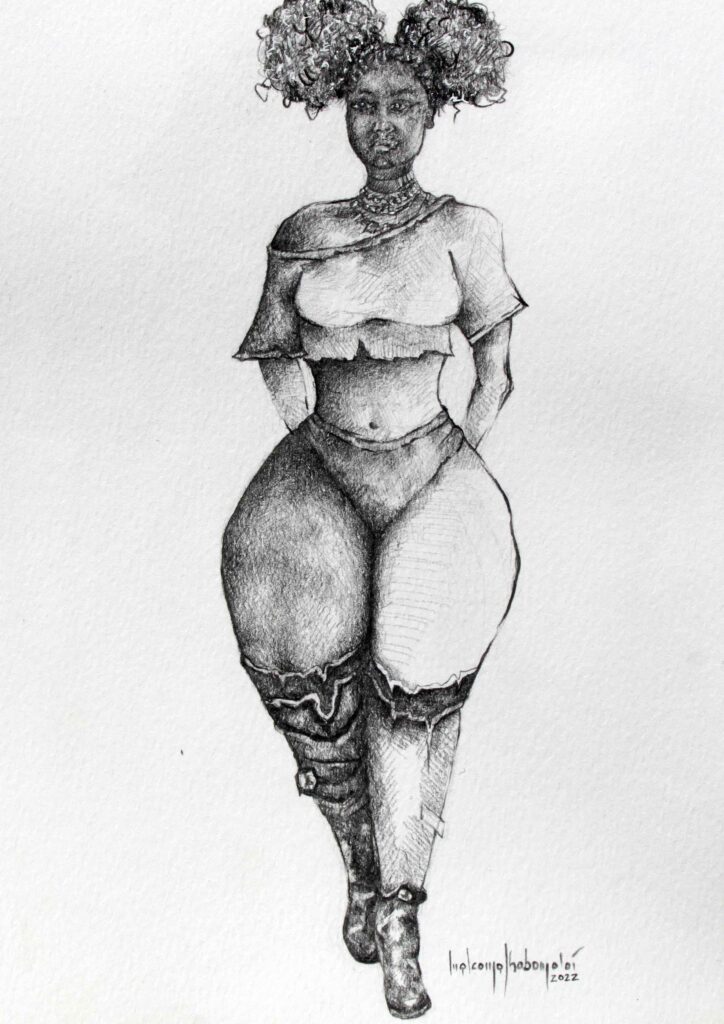
Slowly women are taking over the world. In my years of teaching, I have realized that girls are much bolder and more involved than boys. In high school already, a considerable number of girls show characteristics of leadership, whereas boys are more reluctant and show less interest in things related and relevant to their future. The ignorance and the lack of participation from boys, hints a deep reality yet to be seen.
The Cliff
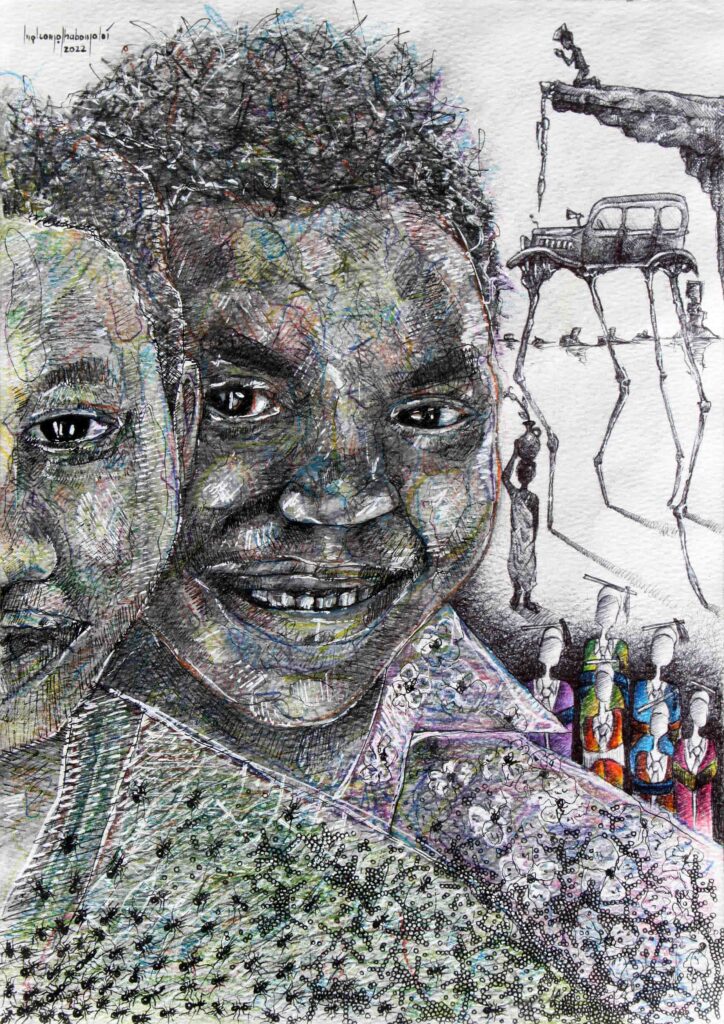
This piece is divided into three sections: foreground, middle ground, and background. A heavy foreground of portraits of young children is depicted in an expressionistic style. Their expressions convey a sense of innocence and joy. They are young, hopeful, and full of productive dreams. They represent a child’s pure spirit, which is loving, caring, and free. Unfortunately, this purity fades over time as children become aware of their immediate surroundings and the harsh realities of life. The vibrant colour used in these portraits alludes to a possible future. Furthermore, there is a visible use of dark and light colour shades, with bright colours representing a beautiful future and dark colours representing the opposite – an uncertain future. This is reinforced by the inclusion of graduates and ants in the composition. The ants represent ethics; moral, social, and work ethics, implying that great things come from hard work and discipline. From the portraits to the graduates, our gaze is drawn to the rest of the middle ground. A small figure is depicted with a pot on his head and a flower inside. This advocated for each person to bear their own weight, regardless of age, gender, or race. Education is personified by the car-like object – the vehicle to education. This helps to round out the foreground. Despite the fact that the two portraits take up most of the composition. The most important scene takes place on the cliff. On this cliff, we see a man praying, a prayer warrior who acts on behalf of all men and women, mothers and fathers who pray for the well-being of their children, especially in these uncertain times. A pen hangs from the cliff a short distance away from the man. The hanging pen represents death, the death of education and morals. Have you ever seen a pen commit suicide? This graphic depicts the dire state of our educational system, which endangers our children’s future. The mountain in the background brings the composition to a close by leading the viewer’s gaze away from the composition and into a world shaped by their thoughts and conclusions.